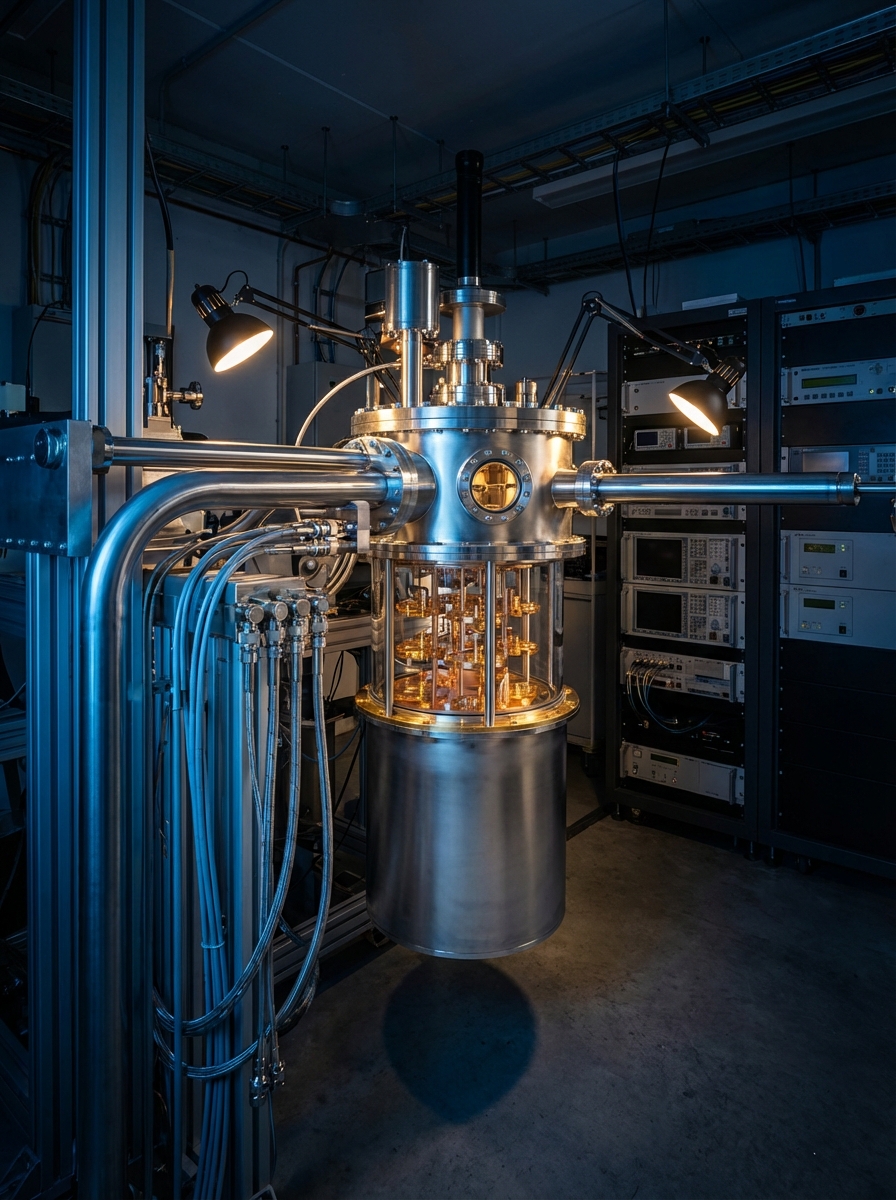
State-of-the-art equipment for low-temperature detector development
Mazin Lab contains state-of-the-art facilities for the development and testing of low temperature detectors and astronomical instruments built using low temperature detectors. The centerpiece of the lab is a suite of dilution refrigerators for cooling devices to millikelvin temperatures and microwave readout systems for characterizing and operating MKID detectors.
UCSB Nanofabrication Facility
Mazin Lab has full access to the UCSB Nanofab, a shared campus cleanroom facility with over 20,000 sq ft of Class 100/1000 space. The Nanofab provides the lithographic capabilities essential for fabricating MKID arrays, including electron-beam lithography, deep-UV stepper lithography, reactive ion etching, and thin-film deposition tools. We use the Nanofab for all photolithographic patterning steps in our MKID fabrication process, complementing the superconducting film deposition done in-house on our AJA system. The facility is staffed by professional engineers and is available to trained users on a 24/7 basis.
W. M. Keck Observatory
UCSB is a member of the University of California Observatories (UCO) consortium, which provides institutional access to the twin 10-meter W. M. Keck Telescopes on Maunakea, Hawai’i — the world’s most scientifically productive ground-based observatory. This access enables Mazin Lab researchers to pursue competitive observing proposals using Keck’s suite of instruments, and provides a potential future platform for deploying MKID-based instruments at one of the premier telescope facilities in the world.
AJA UHV Superconducting Deposition System
This system, owned and controlled by our lab, is an incredibly powerful tool for making high quality superconducting films such as PtSi, TiN, Nb, and Hf that are the basic building blocks of MKIDs. The AJA system is capable of handling 6" wafers inside its own soft-wall clean room, enabling in-house control of the critical deposition steps that determine MKID performance.
Leiden Cryogenics Dilution Refrigerator
Our Leiden fridge arrived in February 2010. This large 450 microwatt fridge, with a base temperature of 12 mK, uses a Cryomech PT-415 pulse tube refrigerator to eliminate the need for liquid cryogens. The fridge contains two 2" clear shot tubes that accommodate special probes which allow us to insert an experiment into a running dilution fridge. This development cuts the time required to cool a device from around three days to three hours, dramatically increasing experimental throughput.
Bluefors Horizontal Dilution Refrigerator
This unique cryogen-free dilution fridge naturally supports instruments at a Nasmyth or Cassegrain focus. It can be tilted up to 50 degrees, and has a 270 mm clear aperture going to the 7.5 mK low temperature stage. This fridge is equipped with optical windows and cryogenic wiring to read out up to 10 feedlines, making it well-suited for testing full instrument dewar assemblies before telescope deployment.
Bluefors LD-250 Dilution Refrigerator
This cryogen-free dilution fridge is equipped with optical windows and cryogenic wiring to read out up to 5 feedlines as part of an MKID order-sorting spectrometer testbed. It is used for development of new MKID array designs and characterization of detector performance under controlled illumination conditions.
Janis Research Adiabatic Demagnetization Refrigerator (ADR)
We have a cryogen-free ADR from Janis Research that served as the dewar for ARCONS, the first UVOIR MKID instrument. This system allows us to cool devices below 100 mK with a hold time of at least 24 hours. It contains optical ports to allow direct illumination of the detector and continues to be used for device testing and development.
Microwave Readout Systems
Our readout infrastructure spans three generations:
-
Analog readout: Extremely rapid IQ sweeps using two Anritsu frequency synthesizers (tuning to a new frequency in less than 100 microseconds), Marki Microwave IQ mixers, and a National Instruments 4-channel 16-bit 1 MS/s digitizer.
-
Gen1 (ROACH-based): Digital readout for ARCONS based on 8 CASPER ROACH boards, capable of reading out 2,048 pixels over 4 GHz of bandwidth.
-
Gen2 (ROACH2-based): Second-generation readout using ROACH2 and custom 2 GSPS 12-bit ADCs, capable of reading out 10,000 pixels in an 11U rack-mount form factor.
-
Gen3 (RFSoC-based): Our newest readout, built on the Xilinx RFSoC4x2 platform. Reads 2,048 channels per board at 1 MHz each, with 5× weight/power reduction and 10× cost reduction compared to Gen2. Fully open-source.
Other Notable Equipment
- Agilent 20 GHz Network Analyzer
- Keysight Fieldfox 12 GHz Network Analyzer with TDR
- Agilent 20 GHz Spectrum Analyzer
- Agilent 500 MHz 4-channel Oscilloscope
- Weinreb HEMT amplifiers, 4–12 GHz @ 5 Kelvin noise temperature
- Low Noise Factory HEMT amplifiers, 4–8 GHz @ 2 Kelvin noise temperature
- Varian turbomolecular pumping station
- Leybold helium leak detector
- Quantum efficiency testbed with monochromator, integrating sphere, and calibrated photosensors
- Westbond wire bonding system
- Nikon microscopes