MEC
MKID Exoplanet Camera at Subaru Telescope — the world's first operational MKID instrument dedicated to high-contrast imaging of exoplanets.
Overview
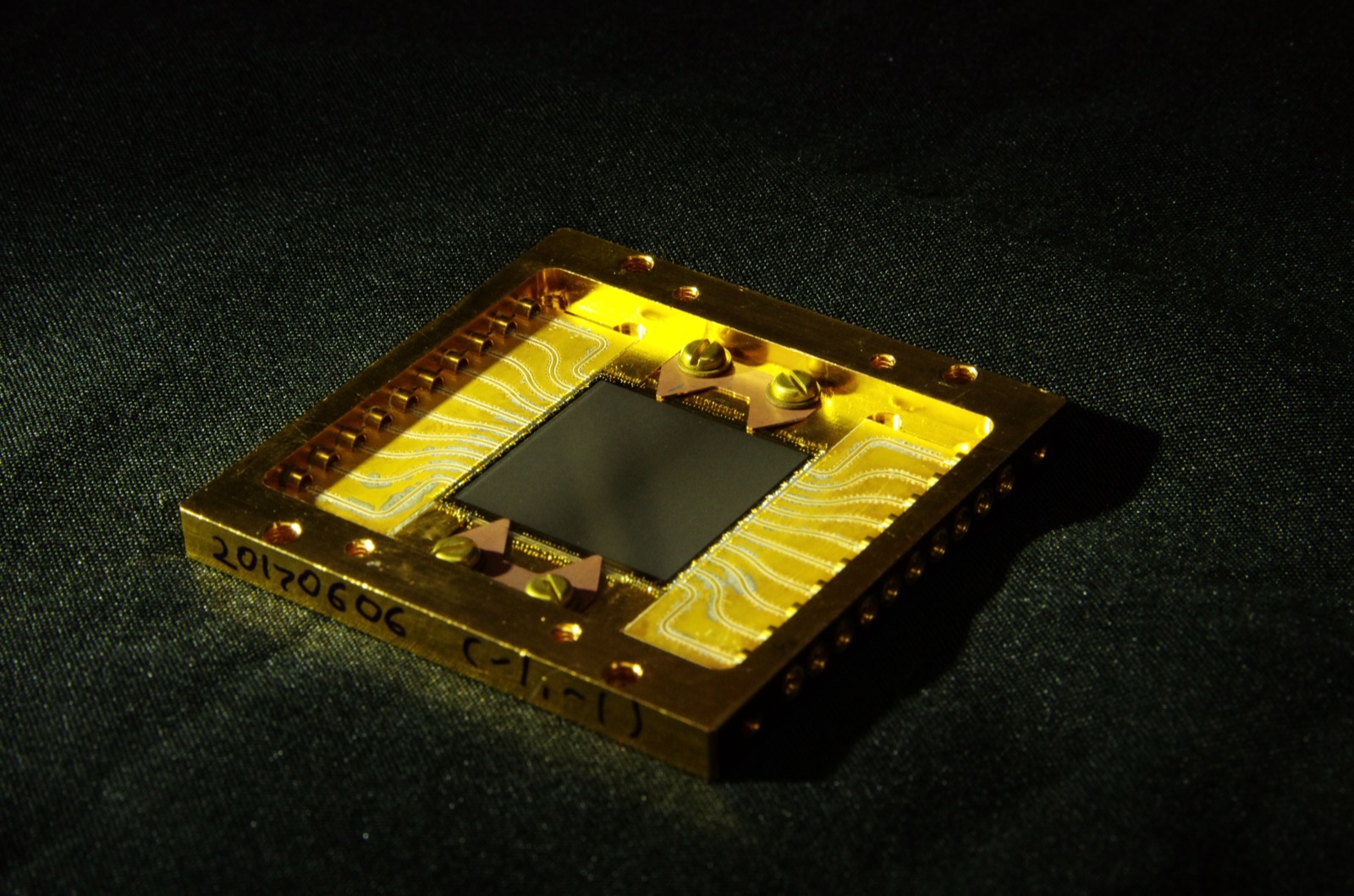
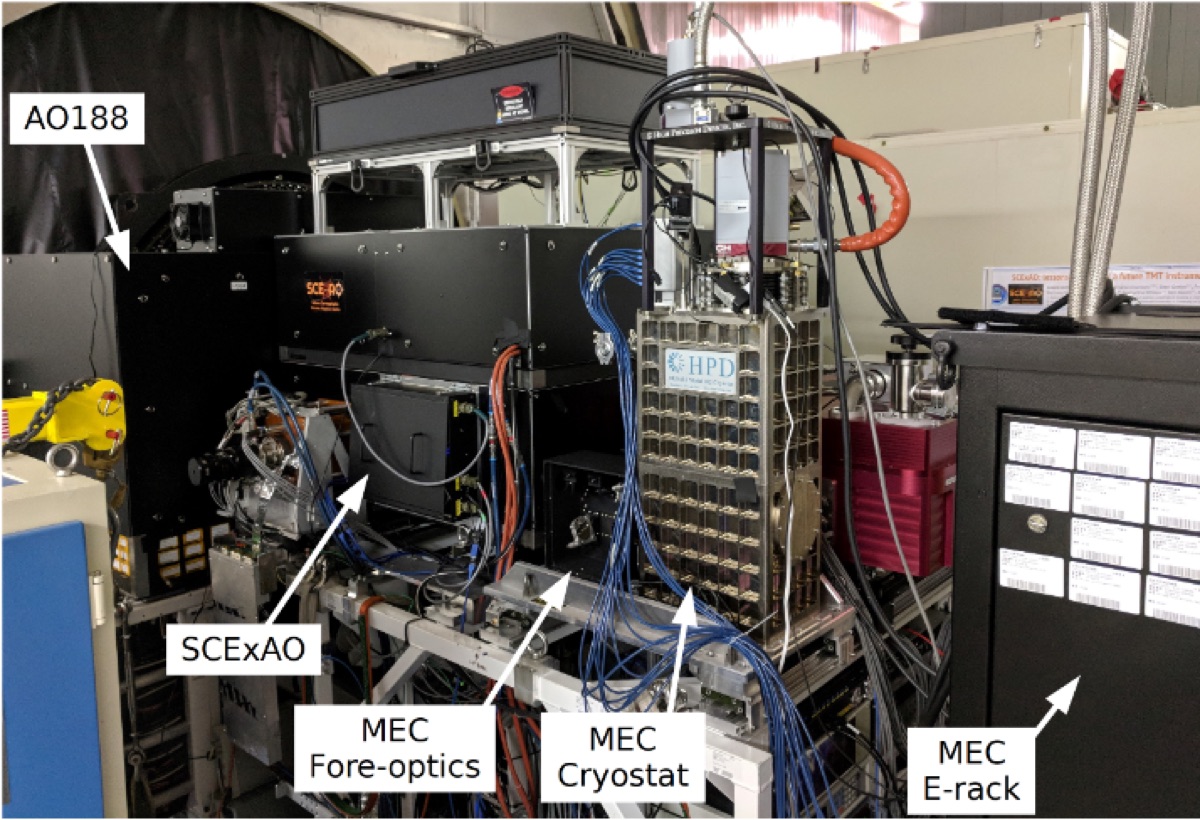
MEC, the MKID Exoplanet Camera, uses our revolutionary Optical/Near-IR Microwave Kinetic Inductance Detectors (MKIDs) to build an instrument of unprecedented capabilities for the direct imaging of extrasolar planets. MEC integrates with the SCExAO extreme adaptive optics system at the Subaru 8-m telescope on Maunakea, Hawaii — one of the world’s premier facilities for high-contrast imaging. Like DARKNESS, MEC achieves improved star-to-planet contrast ratios over conventional Integral Field Units, but from a larger telescope at a better site.
MEC’s 20,440 pixel array provides z-J band (800–1,400 nm) coverage as both an integral field unit and a focal-plane wavefront sensor, targeting contrasts of 10^-7 at 2λ/D separation from host stars.

Advantages Over Conventional IFUs
-
Simplified optical design with high throughput — The MKID array replaces dispersive optics, lenslet arrays, and separate detector read electronics, reducing optical surfaces and improving throughput.
-
Spectral speckle suppression — Operating from 800–1,400 nm with energy resolution R~10 at 1 µm enables spectral differential imaging to suppress quasi-static speckles.
-
Photon-counting with zero read noise and zero dark current — Individual photon detection with microsecond timing enables active speckle control via focal-plane wavefront sensing and time-domain Stochastic Speckle Discrimination (SSD).
Published Science Results
Discovery of Companion to HIP 109427
MEC detected a low-mass, 6 au separation companion to HIP 109427 using simultaneous total-intensity and Stochastic Speckle Discrimination imaging, demonstrating the power of photon statistics for high-contrast imaging.
Steiger, S. et al. (2021). SCExAO/MEC and CHARIS Discovery of a Low-mass, 6 au Separation Companion to HIP 109427 Using Stochastic Speckle Discrimination and High-Contrast Spectroscopy. AJ, 162, 44. DOI: 10.3847/1538-3881/ac02cc
Discovery of Low-Mass Companion to HIP 5319
SCExAO and Keck direct imaging discovery of a low-mass companion around the accelerating F5 star HIP 5319.
Swimmer, N. et al. (2022). SCExAO and Keck Direct Imaging Discovery of a Low-mass Companion Around the Accelerating F5 Star HIP 5319. AJ, 164, 152. DOI: 10.3847/1538-3881/ac85a8
Photon Statistics with SCExAO/MEC
Demonstration of Stochastic Speckle Discrimination using the non-Gaussian statistics of coherent speckle light to improve contrast.
Steiger, S. et al. (2022). Probing Photon Statistics in Adaptive Optics Images with SCExAO/MEC. AJ, 164, 186. DOI: 10.3847/1538-3881/ac922f
Dark Count Rate Characterization
Characterization of the dark count rate of a large-format MKID array, establishing the noise floor for MEC observations.
Swimmer, N. et al. (2023). Characterizing the Dark Count Rate of a Large-Format MKID Array. Optics Express, 31, 10775. DOI: 10.1364/OE.485003
Instrument Paper
The MEC Instrument Paper is published in PASP. See also the UCSB press release.
Funding
NSF has awarded funding to upgrade MEC (August 2024). MEC was originally funded by the Heising-Simons Foundation and the National Science Foundation.