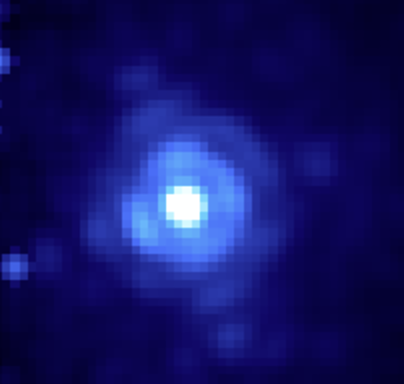
Key discoveries and results from our instruments
Mazin Lab instruments have produced a growing body of peer-reviewed science results. The highlights below represent on-sky demonstrations of MKID capabilities as well as detector physics discoveries that open new observational modes.
Discovery of Companion to HIP 109427
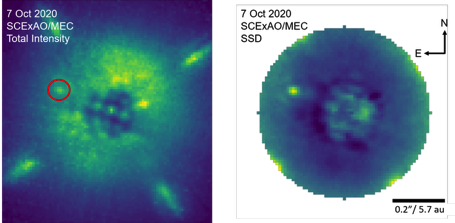
MEC detected a low-mass stellar companion to HIP 109427 using simultaneous total-intensity and Stochastic Speckle Discrimination (SSD) imaging. This result demonstrated that the non-Gaussian photon statistics of coherent speckle light can be exploited to improve contrast beyond what total-intensity coronagraphy alone achieves.
Instrument: MEC at Subaru/SCExAO
Steiger, S. et al. (2021). SCExAO/MEC and CHARIS Discovery of a Low-mass, 6 au Separation Companion to HIP 109427 Using Stochastic Speckle Discrimination and High-Contrast Spectroscopy. AJ, 162, 44. DOI: 10.3847/1538-3881/ac02cc
Discovery of Low-Mass Companion to HIP 5319
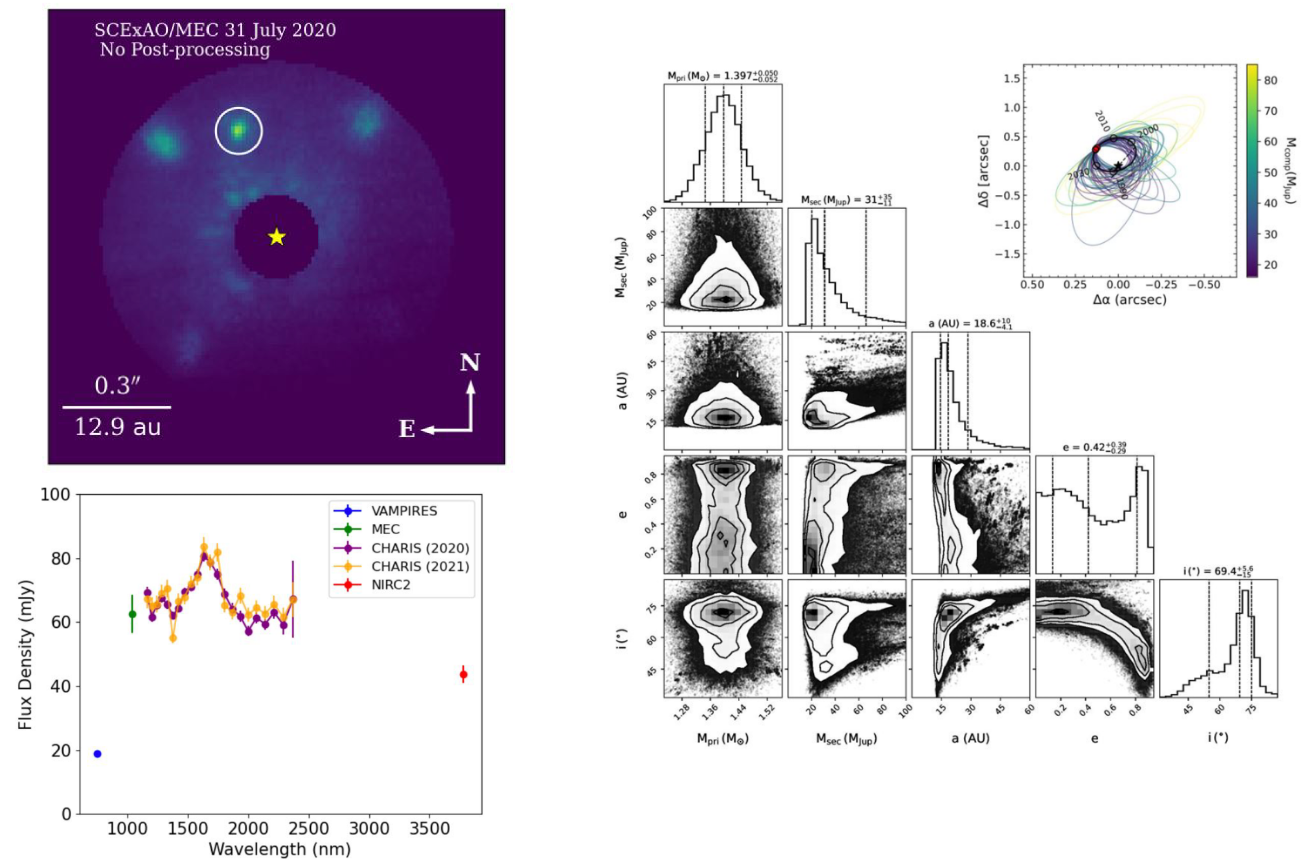
SCExAO and Keck direct imaging discovery of a low-mass companion around the accelerating F5 star HIP 5319, further demonstrating MEC’s capabilities for high-contrast direct imaging in z-J band.
Instrument: MEC at Subaru/SCExAO
Swimmer, N. et al. (2022). SCExAO and Keck Direct Imaging Discovery of a Low-mass Companion Around the Accelerating F5 Star HIP 5319. AJ, 164, 152. DOI: 10.3847/1538-3881/ac85a8
Photon Statistics with SCExAO/MEC
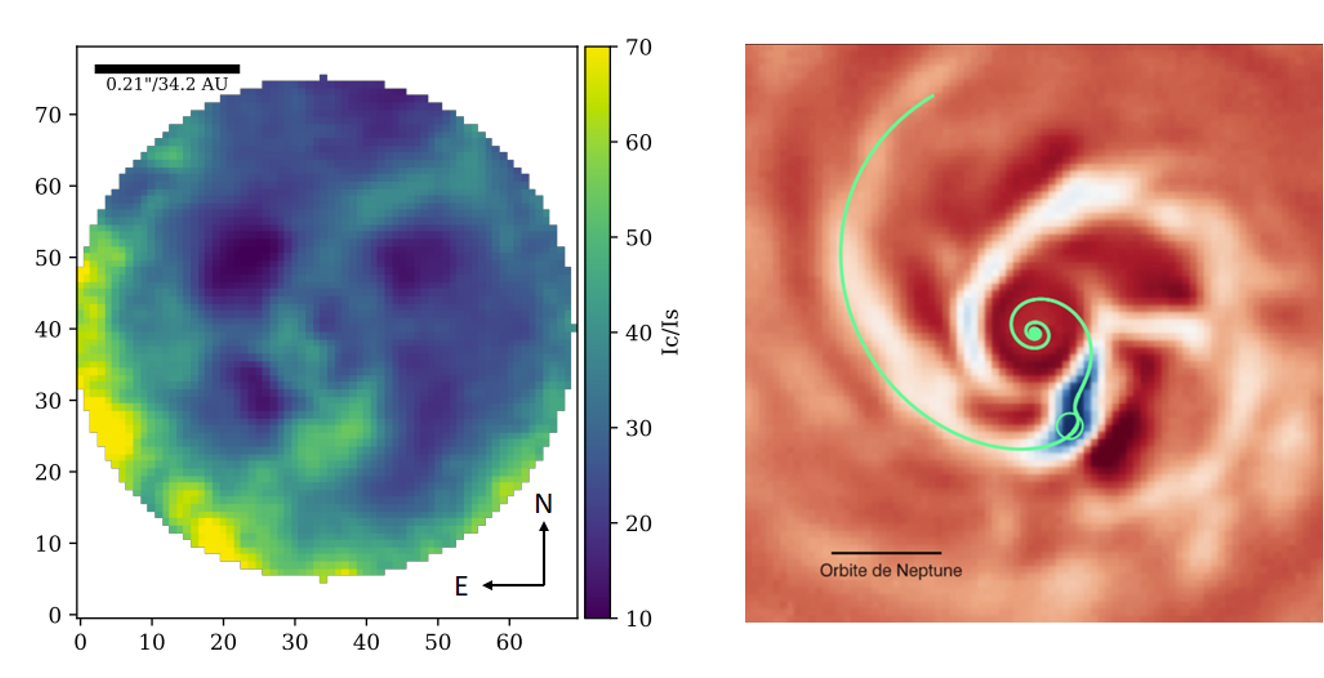
A systematic demonstration of Stochastic Speckle Discrimination using MEC’s photon-counting capabilities. The non-Gaussian intensity statistics of coherent stellar speckle light can be used to statistically separate speckle from incoherent planet light, providing an additional contrast gain over standard coronagraphic imaging.
Instrument: MEC at Subaru/SCExAO
Steiger, S. et al. (2022). Probing Photon Statistics in Adaptive Optics Images with SCExAO/MEC. AJ, 164, 186. DOI: 10.3847/1538-3881/ac922f
Dark Count Rate Characterization of MKID Arrays
A careful characterization of the intrinsic dark count rate in MKID arrays, identifying sources of spurious photon events and their impact on high-contrast imaging performance. This work provides quantitative constraints on achievable contrast limits with MKID-based coronagraphic instruments.
Instrument: MEC at Subaru/SCExAO
Swimmer, N. et al. (2023). Characterizing the Dark Count Rate of a Large-Format MKID Array. Optics Express, 31, 10775. DOI: 10.1364/OE.485003
Membraneless Phonon Trapping Improves MKID Energy Resolution
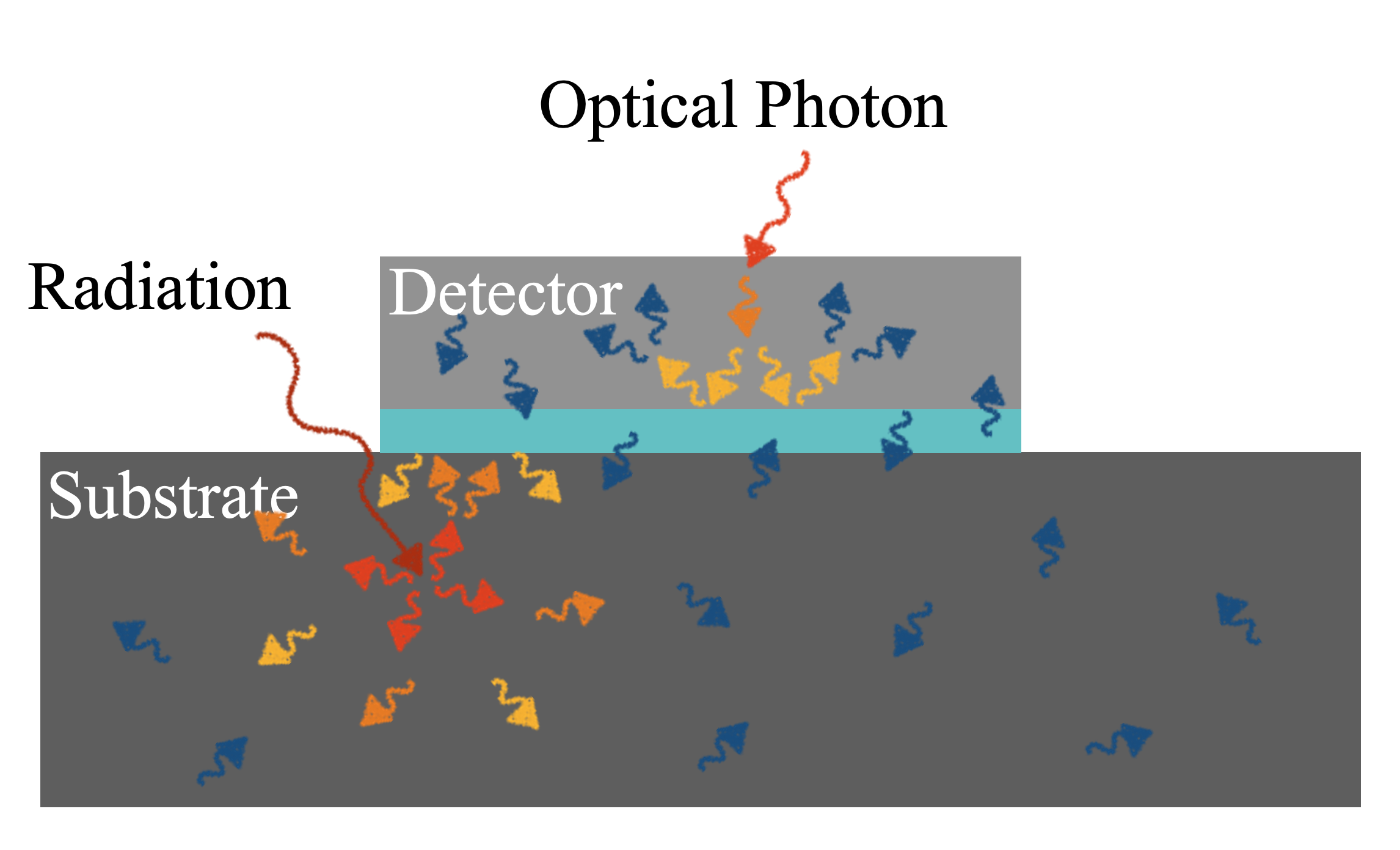
A demonstration that phonon trapping — a technique to confine phonon energy within the absorbing region of an MKID and prevent loss into the substrate — can be achieved without the fragile membrane structures previously required. Published in Physical Review Letters, this result enables fabrication of higher-energy-resolution MKID arrays without the mechanical fragility of suspended membranes.
Zobrist, N. et al. (2022). Membraneless Phonon Trapping and Resolution Enhancement in Optical Microwave Kinetic Inductance Detectors. PRL, 129, 017701. DOI: 10.1103/PhysRevLett.129.017701