Twin A (on Earth) and twin B (in spaceship moving at speed V) synchronize their clocks in the usual way, i.e. (x', ct') = (0, 0) and (x, ct) = (0, 0) are the same event. When twin B's clock reads time T, he uses his rockets to instantaneously reverse his direction of travel; now the Earth approaches him at speed V. When he arrives at the Earth, he uses his rockets to "stop"; now he is at rest on the Earth.
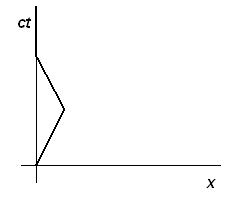
a) Instantaneous acceleration causes the origin of S' to "jump" to a new location. Find the location of the origin of S' (as seen by S) for each leg of the trip, including the end when twin B is at rest on Earth.
b) After twin B stops on Earth, he meets up with A and they compare ages. How much older is twin A?
Twins A and B are both at rest on Earth. Twin B gets in a spaceship, then accelerates away from Earth at rate a0 until his clock reads time T. He then reverses his rocket engines and accelerates toward Earth until his clock reads time 3T. He then reverses his rockets again and accelerates away from Earth, causing him to "land softly" on Earth when his clock reads time 4T. Assume the rocket engines have a constant thrust as measured by twin B.
a) Draw a spacetime diagram for this situation.
b) For the first part of the trip (when twin B's clock reads 0 < τ < T), find the velocity of twin B as a function of t, as measured by twin A.
c) An event along the first part of the worldline of twin B occurs at proper time τ (again, assume 0 < τ < T ). Find the value of t for this event in terms of τ. Wikipedia's integral table is recommended.
d) If a0 = g = 10 m / s2, and T = 1 year, how much has each twin aged when twin B returns?
a) Consider a rocket starting at x = xs at time t = 0, and accelerating with proper acceleration a0. If its event horizon is located at the origin of the (x, ct) frame, what is the value of xs?
b) Find t and x for this rocket as a function of τ. Wikipedia's integral table is recommended.
c) Find the "4-D spacetime distance" between the origin of the (x, ct) frame and an event located on the rocket's worldline at proper time τ.
d) Is the "4-D length" of the position 4-vector equal in both frames?