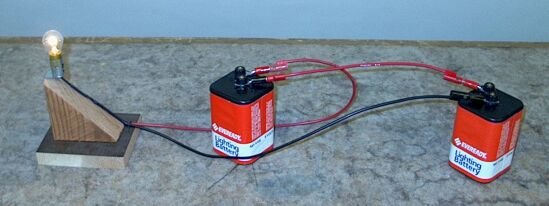
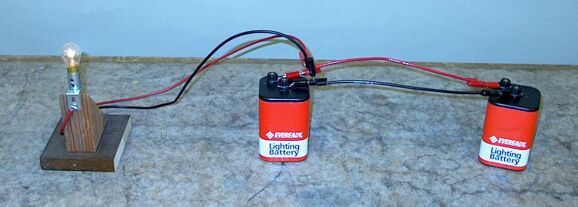
Connect one pair of (six-volt) batteries together in series with one (12-volt) lamp, as in the top photograph, and one pair in parallel with the second (12-volt) lamp, as in the bottom photograph. The lamp connected with the batteries in series burns more brightly than the one connected with the batteries in parallel.
As demonstration 64.09 -- Ohm’s law, shows, the current that passes through a (resistive) load that has a voltage placed across it is inversely proportional to the resistance of the load, and proportional to the voltage, or i = V/R, where i is the current (in amperes), R is the resistance (in ohms), and V is the voltage (in volts). We can also write this as V = iR. For materials whose resistance remains constant regardless of the applied voltage, this relationship is linear. Materials that behave this way are called ohmic materials.
One volt equals one J/C, and one ampere, the unit of current, equals one C/s. From the equations above, we see that one ohm equals one J/(A2 · s), or one W/A2, and that the power dissipated in a resistive load, in watts, equals iV or i2R.
Because the resistance of the filaments in the lamps changes as they heat up when current passes through them, the filaments do not behave ohmically. Though this change in resistance is significant, for this demonstration the general behavior of the lamps is close enough to that of a normal resistor that we can see from their relative intensities the difference in power dissipated by the lamps in the two different configurations.
If we connect a power supply or battery to a resistive load, the load draws current according to the equation i = V/R. (This is true as long as the power supply or battery can provide this current. If not, the load will draw less current.) As noted above, the lamps in this demonstration are rated for operation at 12 volts. If we connect one lamp across one of the six-volt batteries, then, the lamp burns moderately brightly, but not as brightly as it would with a potential difference of 12 volts placed across it. If we connect another battery in parallel with the lamp and the first battery, the potential difference across both batteries and the lamp is still six volts, so the brightness of the lamp does not change.
If we connect two batteries in series, however, the potential difference between the free positive terminal of one battery and the free negative terminal of the other is 12 volts, the rated operating voltage for the lamps. If we now connect the other lamp across this 12-V potential difference, it draws significantly more current, and glows much more brightly, than the one in the parallel circuit. (Because of the non-ohmic behavior of the filaments, noted above, they do not draw twice the current at 12 volts that they do at six volts. The difference, however, is great enough that we can clearly see the greater power dissipated in the lamp operated at 12 volts, compared to the power dissipated in the lamp operated at six volts, as the photographs above show.