(Thanks to Prof. Beth Gwinn for the inspiration for this demonstration.)
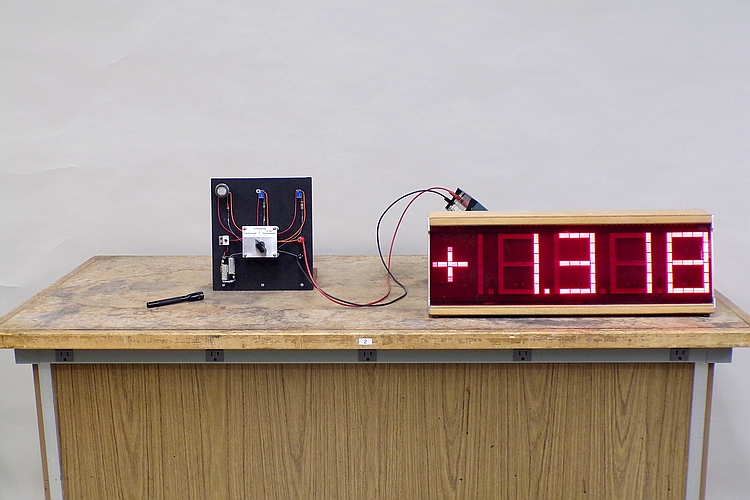
The apparatus sitting on the left in the photograph above has mounted near the top, from left to right, a CdS photocell, a Si photodiode and a Si npn phototransistor, each connected in series with a resistor. You can select the desired pair by means of the switch in the center. When you close the small switch at left, the selected pair is connected across the (3-volt) battery pack, with the semiconductor device connected to the positive teminal, and the resistor connected to the negative terminal, the pair constituting a voltage divider. The voltmeter is connected across the resistor. Blocking the ambient light with your hand increases the resistance of the device, and the output voltage decreases. When you shine the beam from the small flashlight (at left in the photograph) on the device, its resistance decreases, and the output voltage increases.
The page for demonstration 64.56 -- Light-emitting diode (LED), gives a fairly detailed description of semiconductors and explains how diodes work, and the pages for demonstrations 64.63 -- NPN transistor switch and 64.64 -- PNP transistor switch, explain how transistors work. Here we examine the operation of three types of photosensitive semiconductor devices, which this demonstration illustrates.
1) CdS photocell
If light falling on a piece of semiconductor material has sufficient energy, it can excite electrons from the valence band into the conduction band. This increases the density of charge carriers in the conduction band, which makes the material more conductive; its resistance decreases. One can use a material that exhibits this behavior in a device called a photocell, or photoconductive cell. This is a device whose resistance decreases when it is illuminated, the change in resistance depending on the intensity of the incident light. (The resistance decreases as the intensity of the light increases, up to a point.) As the energy of the light increases above the minimum energy necessary to excite electrons from the valence band to the conduction band, there is a rapid increase in the absorption of the light by the material. This reduces the depth to which the light penetrates the material, and thus its effect in exciting electrons into the conduction band. As a result, the material is photoconductive over a fairly narrow wavelength range of light.
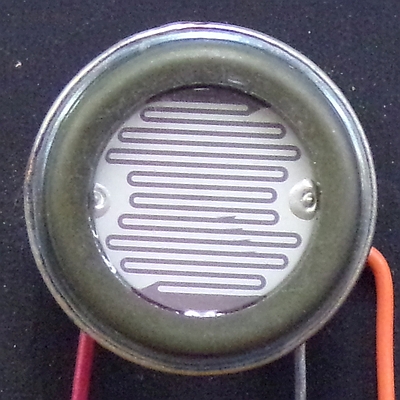
Some common materials used to make photocells are cadmium sulfide (CdS), cadmium selenide (CdSe) and cadmium telluride (CdTe). Typically, the material is deposited on a ceramic substrate, and then two electrodes are deposited over the semiconductor layer. Usually these electrodes have fingers that sit between the fingers of the opposite electrode to leave a serpentine path of exposed semiconductor between them. (Other configurations would result in too high a resistance between the electrodes for the device to be useful.) CdS is sensitive to light in the middle of the visible spectrum (~5,300 Å), CdSe is sensitive to light having a wavelength of around 7,200 Å, and CdTe is sensitive to light of about 8,400 Å.
The device used in this demonstration (shown above) is an RCA SQ2546 CdS photocell.
2) Si photodiode
The photodiode comprises a p-n junction, as does any other diode, and when not exposed to light, it exhibits low resistance when forward biased and extremely high resistance when reverse biased. (Actually, even when it is exposed to light, you can easily observe this behavior.) Placing a forward bias voltage across the diode causes electrons in the n-type material (cathode) to cross the p-n junction into the p-type material (anode), and holes in the anode to cross into the cathode, causing a current to flow. A reverse bias voltage draws electrons in the cathode and holes in the anode away from the junction, creating a depletion region (or depletion layer) around the junction. Just as thermal energy can produce electron-hole pairs, which give rise to a reverse-bias current, light of sufficient energy shining on the diode can create electron-hole pairs in the depletion region, and thus increase this reverse-bias current. If the rate at which the light produces charge carriers is much greater than the rate at which they are produced thermally, then the reverse bias current is directly proportional to the intensity of the light (photon flux).
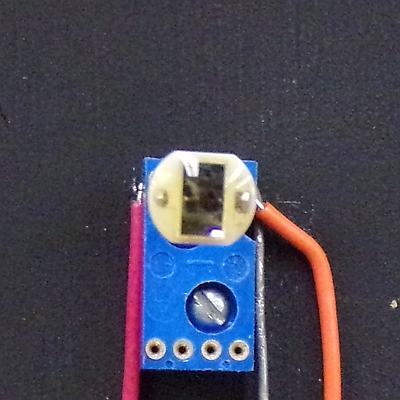
The photodiode used in this demonstration (shown above) is an SD4552 silicon photodiode (made by Meredith Instruments).
3) Si phototransistor
A phototransistor is a three-layer device, similar to a bipolar junction transistor except that the collector-base junction is exposed so that one can shine light on it through a window. As in normal use of a bipolar transistor, the collector-base junction is reverse biased. When one shines light on it, this produces electron-hole pairs, which give rise to a reverse bias current across the junction. This in turn charges the base region so that the base-emitter junction is now forward biased, to produce a larger current in the collector. This is simlar to the operation of a standard bipolar junction transistor, except that instead of applying an electrical bias to the base relative to the emitter to control the current through the device, one shines light on the base-collector junction.
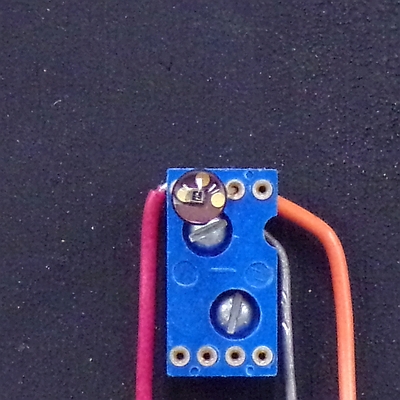
Some phototransistors have only two leads – one to the collector and one to the emitter. Some also have a lead going to the base, as does the one used in this demonstration. This allows one to apply an electrical bias to the base to adjust the photosensitivity of the device. It also allows for the use of the device as a photodiode if desired. One just wires the collector and base, instead of the collector and emitter.
The device used in this demonstration (shown above) is a Fairchild FPT100 npn silicon planar phototransistor.
References:
- 1) Howard V. Malmstadt, Christie G. Enke and Stanley R. Crouch. Electronics and Instrumentation for Scientists (Menlo Park, California: The Benjamin/Cummings Publishing Company, Inc., 1981), pp. 55, 92, 94-95, 168.
- 2) Diefenderfer, A. James. Principles of Electronic Instrumentation (Philadelphia: W. B. Saunders Company, 1979), pp. 398-403.