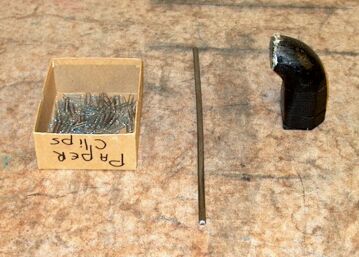
Hold the iron rod vertically with one end touching the paper clips. When you lift the rod, it should not pick up any paper clips, which shows that it is not magnetized. (If it does pick up paper clips, drop the rod, oriented horizontally, on the table or the floor, so that it does not land end on. This should demagnetize it.) Now bring one end of the magnet close to the top end of the rod. (You will have to use the hand in which you are holding the rod to keep the magnet from touching it. Otherwise the magnet will snap onto the end of the rod.) As you lift the rod, it picks up some of the paper clips, which remain stuck to the rod when you remove the magnet. If you touch the rod with the magnet, it picks up more paper clips. In either case, if you now turn the magnet around to bring the opposite pole close to the top of the rod, or to touch it, the paper clips fall from the rod.
The iron rod exhibits ferromagnetism. A ferromagnetic material exhibits spontaneous magnetization, that is, it possesses permanent magnetic dipoles. These occur via the parallel alignment of atomic magnetic dipoles within small regions, anywhere from about 0.1 mm to a few mm in length, called domains. Within a single domain, all the atomic dipoles are aligned parallel with each other, and the domain possesses a magnetic moment. In an unmagnetized piece of material, these domains are randomly oriented, so that their magnetic moments cancel, and the piece of material does not possess a magnetic moment. The material is strongly attracted by a magnetic field, and when it is placed in a magnetic field, two things happen. Larger domains whose magnetic dipoles are aligned with the magnetic field grow at the expense of neighboring smaller domains whose magnetic dipoles are not aligned with it, and domains whose magnetic dipoles are not aligned with the field rotate to align them with it. As a result, the material now has a magnetic moment; it has become magnetized and will itself attract other ferromagnetic objects, whether they are magnetized or not. (See demonstrations 68.69 -- Magnetic materials and 68.60 -- Domains models.)
As noted above, the domains in a piece of ferromagnetic material align with an external magnetic field, which results in the material itself becoming magnetized. When you bring one pole of the magnet near one end of the unmagnetized iron rod, then, the domains near that end of the rod align with the applied magnetic field. This produces a net magnetic dipole at that end of the rod, which causes domains further down the rod to align with the applied field, until the entire rod is magnetized in the direction of the applied field. The rod, now magnetized, can pick up paper clips, which become polarized in the same direction as the end of the rod, and are thus attracted to it. Because the intensity of the magnetic field decreases rapidly with distance from the pole of the magnet, the effect is much stronger when you touch the magnet to the end of the rod. The rod sticks to the magnet, and more paper clips stick to the other end of the rod than when you merely brought the magnet close to the rod.
When you turn the magnet around so that the opposite pole is near the top end of the rod, this causes the domains to reverse their polarity. When this happens, the field at the bottom end of the rod is now opposite to the direction in which the paper clips had become polarized when you picked them up with the rod. As a result, they are repelled by the rod, and they fall.
Depending on how you handle the magnet and rod while you perform this demonstration, the rod may or may not stay magnetized. Besides aligning the domains in the rod by applying a magnetic field, you can also align or scramble them by means of a mechanical shock. If you were to drop the rod on its end or strike the end with a hammer, you could magnetize it along its length. Similarly, if you drop it so that it lands in some random way, you can knock the domains into a variety of orientations so that their magnetic moments essentially cancel, and the rod becomes demagnetized. A configuration in which the domains are randomly oriented has lower energy than one in which they are all aligned parallel to each other. A mechanical shock in which there is no single direction of strong impact will thus tend to misalign the magnetic dipoles and demagnetize the rod. This is why if the rod becomes magnetized, you can demagnetize it by dropping it as described above.