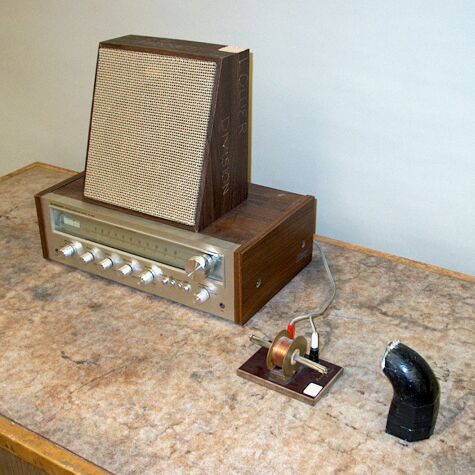
To the right of the receiver in the photograph above is a coil, which is connected to the phonograph input of the amplifier. Running through the center of the coil is a bundle of straightened paper clips. When you bring one pole of the magnet near one end of the bundle of paper clips, this causes a realignment of the magnetic domains in the paper clips, which induces noise in the coil, which you hear through the speaker as a sort of rushing sound or series of clicks, depending on how quickly you approach the paper clips with the magnet. When you bring the opposite pole of the magnet close to the same end of the paper clips, you align the magnetic domains in the opposite direction, and you again hear the noise. (You can also do this by bringing the pole of the magnet that you first used, to the opposite end of the bundle of paper clips.)
In ferromagnetic materials, each atom possesses a magnetic dipole, and the magnetic dipoles of neighboring atoms align parallel with each other in groups called domains. (See demonstrations 68.60 -- Domains models, and 68.69 -- Magnetic materials.) These domains range in size from about 0.1 mm to a few mm in length, and because all of the atomic magnetic dipoles within them are aligned parallel with each other, they have permanent magnetic dipoles. In an unmagnetized piece of material, these domains are randomly oriented so that their magnetic dipoles cancel, and the material has no net magnetic dipole. It is, however, strongly attracted by a magnetic field. When you place the material in a magnetic field, larger domains whose magnetic dipoles are aligned with the field grow at the expense of neighboring smaller domains whose magnetic dipoles are not aligned with it, and domains whose magnetic dipoles are not aligned with the field rotate so as to align them with it. The material now possesses a magnetic dipole. It is now magnetized and will attract other ferromagnetic objects, whether they are themselves magnetized or not.
Though Pierre-Ernest Weiss postulated the existence of magnetic domains in 1906, the prevailing idea was that the magnetization of a piece of ferromagnetic material occurred in a smooth, continuous way. In 1919, Heinrich Barkhausen was performing experiments involving magnetism and accoustics. While working with an apparatus similar to the one used in this demonstration, he observed that as he brought a magnet near the iron core that was inserted in the coil, he heard a series of clicks, which indicated that the change in magnetization of the iron occurred in steps.
As you slowly bring the magnet near the bundle of paper clips, in response to the increasing magnetic field, the domains within them rotate to align their magnetic dipoles with the field. When a domain changes its position, this produces a change in the magnetic flux within the coil, which induces an emf in the coil. The resulting current produced in the coil is amplified and sent to the speaker, and you hear a click. If you move the magnet quickly, the clicks occur in rapid succession and produce a sort of whooshing sound. If you move the magnet slowly, you can produce discrete clicks. When all of the domains have flipped to align with the field, you can either bring the magnet to the opposite end of the bundle of paper clips, or bring the opposite pole of the magnet to the same end of the paper clips, and listen to the clicks as the domains now flip in the opposite direction.
References:
- 1) LibreTexts Engineering, Section 5.1.5: Magnetic Domains.
- 2) National MagLab page on the Barkhausen Effect.