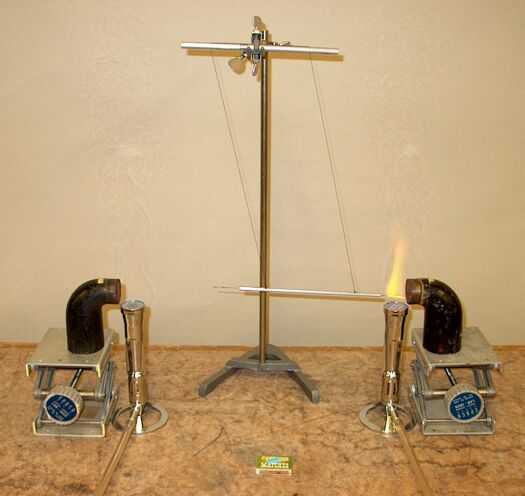
At each end of the pendulum bob is a straightened section of a jumbo paper clip. Light the Méker burners, and then raise the pendulum to one side so that the end of the pendulum bob sticks to the magnet. (You can also light the burners after the pendulum bob is stuck to one of the magnets.) The end that is stuck to the magnet is heated by the burner flame until it reaches the Curie temperature and is thus no longer attracted to the magnet. The pendulum bob swings to the other side, where the other end of the bob is then attracted to the other magnet and sticks to it. This end is now heated in the burner flame until it reaches the Curie temperature and no longer stays on the magnet, and the whole process repeats.
Iron, the main component in the paper clips used for the ends of the pendulum bob, exhibits a property called ferromagnetism. This is the presence of spontaneous magnetization in a material even without any externallly applied field. This arises from the parallel alignment of the magnetic dipoles of the atoms within small regions, anywhere from about 0.1 mm to a few mm in length, called domains. Within a single domain, the exchange interaction between valence electrons on neighboring atoms causes all the atomic dipoles to be aligned parallel with each other, and the domain possesses a magnetic moment. In an unmagnetized piece of material, these domains are randomly oriented, so that their magnetic moments cancel, and the piece of material does not possess a net magnetic moment. The material is strongly attracted by a magnetic field, however, and when placed in a magnetic field it acquires a magnetic dipole; it becomes magnetized. Besides iron, the only elements that are ferromagnetic are cobalt, nickel, gadolinium and dysprosium, though many other compounds and alloys of these and other elements are also ferromagnetic.
The difference in energy between the magnetized and unmagnetized states of the domains is on the order of a tenth of an electron volt per atom. The spontaneous magnetization associated with ferromagnetism is thus temperature dependent. At T = 0 K, all the atomic magnetic dipoles that could be aligned are aligned, and the spontaneous magnetization is at its maximum. The material is strongly attracted to a magnet. As the temperature increases, though, thermal motion tends to disrupt the correlation of the atomic magnetic dipoles, and increasing numbers of dipoles break from the parallel alignment of the others, with a corresponding decrease in the magnetization. As the temperature approaches the Curie temperature, TC (also called the Curie point, named for Pierre Curie, who discovered it), the number of randomly oriented dipoles increases rapidly, and the magnetization begins to decrease rapidly. At TC, all of the magnetic dipoles are randomly oriented. There is no alignment, and the material is no longer ferromagnetic. For iron, the Curie temperature is 1,043 K. For cobalt it is 1,388 K, for nickel it is 627 K, for gadolinium it is 293 K, and for dysprosium it is 85 K.
Above the Curie temperature, since each atom has a magnetic dipole, but there is no alignment among the atomic dipoles, the material is paramagnetic, and is only weakly attracted by a magnetic field. (See demonstration 68.69 -- Magnetic materials.) Thus, the pendulum bob starts out with one end stuck to its magnet. As that end is heated by the burner flame, it eventually reaches the Curie point, and is so weakly attracted by the magnet that gravity pulls the pendulum bob down to swing toward the other magnet, where that end of the bob is attracted and sticks. That end is now heated by its flame, reaches the Curie point, and is so weakly attracted to its magnet that the bob falls to swing back to the first magnet. By this time, the first end of the bob has cooled to far enough below the Curie point that it is again attracted to its magnet and sticks. Then the cycle repeats.
References:
- 1) Eisberg, Robert and Resnick, Robert. Quantum Physics of Atoms, Molecules, Solids, Nuclei, and Particles (New York: John Wiley & Sons, Inc., 1974) pp. 533-45.
- 2) Hyperphysics table of Curie temperatures.