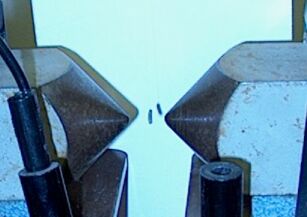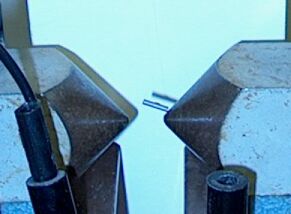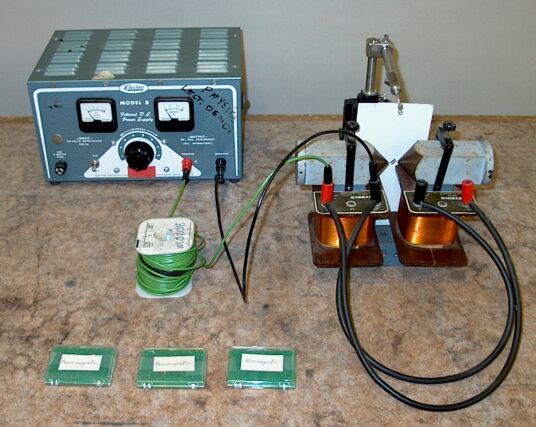
Three small metal rods, one of bismuth, one of aluminum and one of iron, are attached via extremely thin filaments to hooks, so that you can suspend them between the pole pieces of an electromagnet. When you do this and then turn the magnet on, the bismuth rod (diamagnetic) orients itself at right angles to the magnetic field (below left), the aluminum rod (paramagnetic) aligns itself with the magnetic field (below center), and the iron rod (ferromagnetic) is strongly attracted to either of the pole pieces (below right). A camera set in front of the apparatus enables you to project an image of the sample between the magnet poles to the class.
Bismuth (diamagnetic)
Aluminum (paramagnetic)
Iron (ferromagnetic)
The magnetic properties of materials arise from the behavior of their electrons. Just as a current flowing in a loop produces a magnetic dipole, through the motions associated with their spin and angular momenta, the electrons in a material produce magnetic dipoles. Whether or not a particular material exhibits a magnetic moment on its own, and how it responds when placed in an external magnetic field, depend on the specific electronic configuration of the material.
In a piece of material placed in a magnetic field, the total magnetic induction is that due to the external field plus the magnetic induction due to the material itself, or:
B = μ0H + μ0M,
where H is the external field strength, and M is the magnetization, the strength of the field due to the magnetic dipoles within the material itself. M is the magnetic dipole moment per unit volume, µ/V. Both H and M have units of A/m. μ0 is the permeability of free space, which equals 4π × 10-7 henrys/m (or T·m/A). B is in teslas.
The magnetization is proportional to the external field strength, and
M =χH,
where χ is the magnetic susceptibility. We can write
B = μ0(1 + χ)H
If χ is negative, then B < μ0H, and the material is diamagnetic. If χ is positive, then B > μ0H, and the material is paramagnetic. We can also express the magnetization in terms of B and χ:
M = (χB)/[μ0(1 + χ)]
This expression indicates that if χ is small compared to one, M ≃ χB/μ0, and μ0M, the contribution from the magnetic moments in the material to B, is small. This is true for materials that are diamagnetic or paramagnetic.Diamagnetism:
As noted above, when a material’s magnetic susceptibility is negative, the material is diamagnetic. When you place it in a magnetic field, the magnetization is in the opposite direction to the external field, and B inside and around the material is smaller than it would be without the material present. This is a consequence of Lenz’s Law. The electron motions induced in the material by the external magnetic field produce a magnetic dipole that opposes the applied field, hence the reduction in the magnitude of the field within the material. We say that the material excludes some of the flux of the applied field from its interior. (See demonstration 72.09 -- Lenz’s Law.) This causes a diamagnetic material to be repelled by a magnetic field. The bismuth rod used in this demonstration is diamagnetic, and when you suspend it in the inhomogeneous field of the magnet, this repulsion causes it to orient itself perpendicular to the field. A short note regarding the diamagnetism of bismuth follows at the end of the section on paramagnetism.
A superconductor below its critical temperature is perfectly diamagnetic. It excludes all flux from its interior, so that χ = -1 and B = 0. If you place a magnet above a piece of superconductive material when it is below its critical temperature, the magnet floats above the superconductor. You can also set a piece of superconducting material over a track made of magnets, and as long as it remains superconducting it will float above the track. (See demonstration 72.10 -- The Meissner effect.) For most diamagnetic substances, though, χ is usually less than 10-5. These materials are weakly repelled by a magnetic field.
Paramagnetism:
As noted above, when a material’s magnetic susceptibility is positive, the material is paramagnetic. This arises from the fact that the atoms in the material possess permanent magnetic dipole moments. These tend to line up with an externally applied magnetic field, the energy of the system being lower when they align parallel to the field than when they align antiparallel to it. When they align parallel to the applied field, they add to it, so that the magnitude of the field within the material is greater than that of the applied field. The material is thus attracted by the external field.
These dipoles arise from the presence of unpaired electrons. Dipoles associated with electrons of opposite spin cancel, and only atoms that have unfilled electronic subshells can have unpaired electrons. Aluminum has one unpaired electron, and it is paramagnetic. When you suspend the aluminum rod between the poles of the magnet, it is attracted by the field, and it orients itself parallel to it.
For most paramagnetic materials, χ ≃ 10-4, and these materials are weakly attracted by a magnetic field.
Thermal energy would tend to randomize the orientation of the dipoles in the material, and thus would reduce the degree to which they align with the applied field. Because of this, the magnetic susceptibility is temperature dependent. For low fields and moderate-to-high temperatures,
χ = C/T,
where C is a positive constant specific to the particular material. This is called the Curie law, after Pierre Curie, who discovered it.
While diamagnetism and paramagnetism generally arise from the electronic structure of materials as described above, some materials do not behave as we might expect based on their electron configuration. Bismuth, the diamagnetic material shown above, has three unpaired valence electrons. Given this fact, we might expect bismuth to be paramagnetic, perhaps strongly so. The nucleus of bismuth, whose atomic number is 83, carries substantial charge, and as a result, spin-orbit coupling (the interaction of the electrons’ spin magnetic moments with the magnetic fields associated with their orbital motion) is very strong, and has greater energy than the electrostatic repulsion among the electrons. This causes a lowering in the energy of the partially filled orbitals containing the unpaired electrons, relative to those of the nearest filled orbitals. As a result, the unpaired electrons are screened by the paired electrons that lie above them, and these paired electrons give bismuth its diamagnetic behavior.
Ferromagnetism:
Ferromagnetism is the presence of spontaneous magnetism in a material even without any externally applied magnetic field. As does paramagnetism, it arises from the presence of magnetic dipoles due to unpaired electrons, but it also involves interactions of the valence electrons on single atoms with each other and with those on neighboring atoms. For example, we’ll examine the case of iron, the element from which this phenomenon gets its name. Iron has six unpaired 3d electrons, which could be distributed among the five 3d suborbitals in at least two ways. They could be spin paired (two in each of three suborbitals), or two could be paired in one suborbital, with the remaining four distributed in separate suborbitals, with their spins parallel. The electrostatic repulsion among the electrons is minimized when they are distributed in separate suborbitals. Also, because of symmetry constraints on the wave function for a pair of electrons with regard to their interchange, the electrons couple via what is called an exchange interaction. This causes their spins to align parallel with each other. As a result, the iron atom has four unpaired spins, aligned parallel to each other, and is thus paramagnetic.
The iron atoms are not isolated, but sit in a lattice among neighboring iron atoms. Similarly to the way the electrons in the single atom couple to each other, electrons in neighboring atoms can couple as well. If the atomic spacing in the lattice is too great, the overlap among the 3d orbitals of neighboring atoms is insufficient for the exchange interaction to lower the system’s energy by aligning the magnetic dipoles of the atoms, and the material is paramagnetic. As the interatomic spacing decreases, the exchange interaction becomes more significant. Over a certain range of interatomic distances the magnetic dipoles of neighboring atoms align parallel with each other, and the material becomes ferromagnetic. Below a certain interatomic distance, the increase in energy associated with having unpaired dipoles aligned parallel with each other instead of antiparallel, exceeds the decrease in energy provided by the exchange interaction, and the material cannot be ferromagnetic. In iron, the interatomic spacing is such that the overall reduction in energy that results from the exchange interaction is near its maximum. The magnetic dipoles of many neighboring atoms thus align parallel to each other, and iron is ferromagnetic. This alignment occurs in small regions of the material, called domains, which are discussed further below.
The only elements that are ferromagnetic are iron, cobalt, nickel, gadolinium and dysprosium. There are, however, many compounds and alloys of these and other elements that are ferromagnetic. Even relatively weak fields strongly attract ferromagnetic materials, for which χ can be as large as 105. When you suspend the iron rod between the magnet poles, it is strongly attracted to one of the pole pieces, and it sticks to it.
In ferromagnetic materials, the difference in energy between the magnetized and unmagnetized states (of the domains) is on the order of a tenth of an electron volt per atom. The spontaneous magnetization associated with ferromagnetism is thus temperature dependent. At T = 0 K, all the dipoles that could be aligned are aligned, and the spontaneous magnetization is at its maximum. As the temperature increases, though, thermal motion tends to disrupt the correlation of the atomic magnetic dipoles described above, and increasing numbers of dipoles break from the parallel alignment of the others, with a corresponding decrease in the magnetization. As the temperature approaches the Curie temperature, TC (also called the Curie point, and also named for Pierre Curie), the number of randomly oriented dipoles increases rapidly, and the magnetization begins to decrease rapidly. At TC, all of the dipoles are randomly oriented. There is no alignment, and the material is no longer ferromagnetic. (See demonstration 68.66 -- Curie point pendulum.) For iron, the Curie temperature is 1,043 K. For cobalt it is 1,388 K, for nickel it is 627 K, for gadolinium it is 293 K, and for dysprosium it is 85 K.
Above the Curie temperature, the material becomes paramagnetic, and the magnetic susceptibility is given by:
χ = C/(T - TC),
which is a modified form of the Curie law for paramagnetic materials, in which χ is not defined for temperatures below TC, for which the material has a permanent magnetization.
Usually, ferromagnetic materials are not magnetized – that is, they have no net magnetic moment – unless they have been placed in an external magnetic field. They do exhibit spontaneous magnetization, but this occurs in small regions, called domains, whose sizes can range from around 0.1 mm to a few mm in length. Within a given domain, all of the magnetic dipoles are aligned, and the domain has a net magnetic moment. The material contains many such domains, which in an unmagnetized piece of material are randomly oriented, so that the material does not possess a net magnetic moment.
When we place a piece of ferromagnetic material in an external magnetic field, two things happen. One is that larger domains whose magnetic dipoles happen to be aligned with the external field grow at the expense of neighboring smaller domains whose magnetic dipoles are oriented in some other direction. The second is that domains whose magnetic dipoles are not aligned with the external field rotate so as to align their magnetic dipoles with the field. The material thus becomes magnetized; it now possesses a magnetic moment, and will attract other (nonmagnetized) objects that are ferromagnetic. (See demonstrations 68.60 -- Domains models, 68.12 -- Induced magnetism and 68.63 -- Barkhausen effect.)
The changes in size and orientation of the domains that occur when a piece of ferromagnetic material is placed in a magnetic field cause subtle changes in the length of the piece of material. This phenomenon is called magnetostriction. In inductive devices that have iron cores, such as transformers, the AC current produces an oscillating magnetic field, which reaches a maximum at every half cycle. The resulting magnetostriction causes an oscillating change in length of the core, creating a mechanical vibration at twice the line frequency (120 Hz in the U.S.). This is the main cause of the hum associated with transformers. (An additional contributor is the attraction of the coil windings to each other that occurs every half cycle (see demonstration 68.39 -- Force between current-carrying wires).)
References:
- 1) Eisberg, Robert and Resnick, Robert. Quantum Physics of Atoms, Molecules, Solids, Nuclei, and Particles (New York: John Wiley & Sons, Inc., 1974) pp. 533-45.
- 2) Berry, R. Stephen, Rice, Stuart A. and Ross, John. Physical Chemistry (New York: John Wiley & Sons, Inc., 1980) pp. 12, 166-7, 390.
- 3) Karplus, Martin and Porter, Richard N. Atoms and Molecules (Reading, Massachusetts: W. A. Benjamin, Inc., 1970) pp. 187-92, 208-11.
- 4) Hyperphysics entry on Spin-orbit interaction. See also the entries on Russell-Saunders or L-S Coupling and on j-j Coupling (j-j coupling is what occurs in bismuth.)
- 5) Hyperphysics entry on Long-range Order in Ferromagnets (Domain sizes; see also the entry on Magnetic Domains.)
- 6) Hyperphysics table of Curie temperatures.
- 7) Hyperphysics entry on magnetostriction.