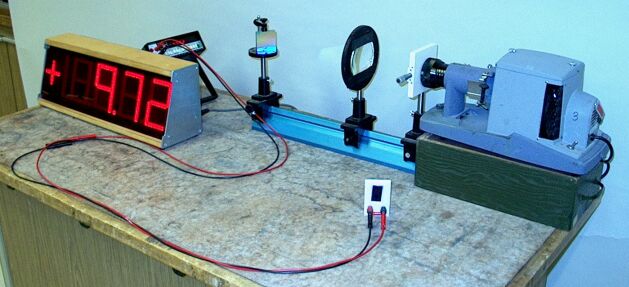
The beam of light from a projector passes through a variable slit and lens to a diffraction grating, from which it is reflected to a screen, where it appears as a color spectrum. A solar cell connected to a voltmeter that is connected to a large readout provides a measure of the intensity of the light incident on the screen. As you move the solar cell across the spectrum on the screen, the voltmeter reading varies with the intensity of the light in the different regions of the spectrum. With the combination of the transmission characteristics of the projector optics and the response curve of the solar cell, the response is low in the ultraviolet and violet regions, and it increases as you move the solar cell toward the red. The peak response is near the orange region, and the response is still high in the red and infrared regions.
William Herschel, in performing experiments in which he used a variety of differently colored darkening glasses in different combinations so that he could use a large telescope to look at the sun, noticed that some combinations gave him a sensation of heat, but little light, and others gave much light, but little heat. Intrigued by these observations, he performed experiments in which he used a prism to refract the sun’s rays, and projected the refracted rays to fall on the blackened bulbs of thermometers. He found that within the visible spectrum, violet rays gave the least heating effect, and red gave the greatest. He also found that while he did not observe any heating effect outside the violet end of the spectrum (ultraviolet), he found that rays outside the red end of the spectrum had greater heating power than those in the red region. He thus showed the existence of infrared light and that it was refrangible as is visible light, and he made the connection between this region of the electromagnetic spectrum and heat. He presented this work (and other work as well) at meetings of the Royal Society of London on March 27, 1800, and on April 24, 1800. It is published in Phil. Trans. Royal Soc. London 90 (1800), pp. 255-283 and Phil. Trans. Royal Soc. London 90 (1800), pp. 284-292.