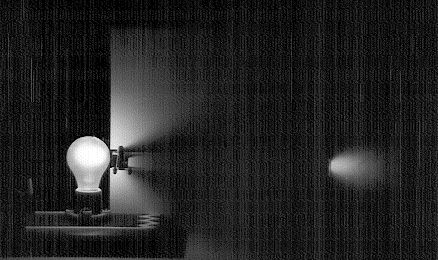
One end of a 12-inch long acrylic rod, one inch in diameter, sits next to an illuminated bulb. The light emitted at the other end of the rod is much more intense than the light radiated by the bulb that has reached the same distance from the bulb. This shows that while the intensity of the light radiated by the bulb diminishes as the inverse square of the distance from the bulb, the intensity of the light as it travels through the acrylic rod does not.
As is illustrated by demonstration 76.06 -- Inverse square frame, the intensity of light emitted by a point source – emitted with equal intensity in all directions – diminishes as the inverse square of the distance from the source. If the intensity of the light at a given distance is I, then at twice that distance it is I/4, at three times that distance it is I/9, and at four times that distance it is I/16, etc. The light emitted by the light bulb in this demonstration diminishes in intensity in this way, except for the light the enters the acrylic rod immediately as it leaves the light bulb.
The light that enters the acrylic rod travels through it to reach the other end in two ways. Any light that travels along the axis of the rod, or at any angle that takes it in a straight line through the opposite face of the rod, merely travels straight through. Light that strikes the wall of the rod, however, reaches the other end in a different way. As illustrated by demonstrations 80.18 -- Refraction tank, and 80.30 -- Laser to acrylic spiral and fiber optics, when light travels from one medium into another medium whose index of refraction is lower than that of the first medium, it is refracted away from the normal to the interface between the two mediums. This means that as the angle of incidence at the interface increases, the angle of refraction increases until at a particular angle, the critical angle, the refracted ray lies along the interface between the two mediums; the angle of refraction equals 90 degrees. For light that is incident on the interface at an angle greater than this, there is no refracted ray, and the light undergoes total internal reflection; all the light is reflected back into the first medium.
The index of refraction of acrylic is 1.495, so if we take the index of air as 1, Snell’s law gives
(1.495) sin θ1 = (1) sin (90),
so the critical angle is
θ1 = sin-1 (1/1.495),
which equals 42°. Most of the light that does not travel straight through the rod strikes the wall of the rod at an angle that is greater than this angle, and thus undergoes total internal reflection as it travels through the rod. Light entering the rod at the end near the bulb thus passes through the rod with little or no attenuation when it exits at the other end.
A piece of optical medium that transmits light in this way is called a “light pipe.” Such devices are commonly used in a variety of electronic instruments for indicator lights and in certain types of displays. For example, when an indicator panel and the circuit board that drives the indicator are oriented so that it is inconvenient to mount the indicator itself on the panel, the designers use a light pipe to carry the light from an LED or lamp mounted on the circuit board, to the spot to be illuminated on the panel. This type of design can make it easier to manufacture and assemble the instrument.