Successful Physics Circus
tosses aside
boring science textbooks
in favor of . . .
By LEAH ETLING-STENTZEL, NEWS-PRESS STAFF WRITER
News-Press Photos
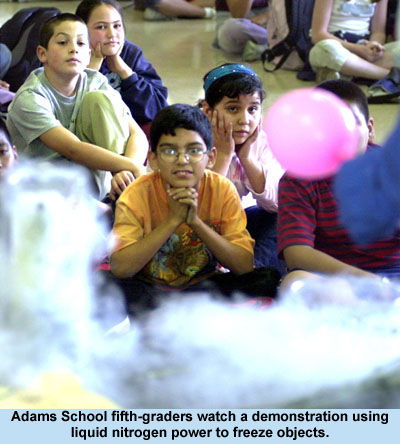 Marshmallows,
that is, frozen with liquid nitrogen in front of the students' eyes.
Marshmallows,
that is, frozen with liquid nitrogen in front of the students' eyes.
"I used to eat them nonfrozen and they taste better frozen," said Adams School sixth-grader Jessica Rodriguez. "It sticks to your tongue."
UCSB graduate students and Adams science teacher Cha Heiden were hoping the memory stuck to their brains, but whether they liked the frozen treats or the Van de Graaff generator's static electricity, a recent visit of the Physics Circus to Adams was a quantum success.
"It's great to get them excited and into science," said Ms. Heiden, who is teaching the school's new science program this year. "They're intrinsically interested, and it provokes interesting questions in class."
Her students laughed, clapped and whispered hypotheses about what would happen in each science trick to each other as the UCSB physicists worked their magic.
The Physics Circus began its Central Coast tour five years ago, when graduate student Abigail Reid and professor Jean Carlson got together and adapted it from a book called the "Flying Circus of Physics," by Jearl Walker.
"The idea is to get students interested in science and physics much younger and dispel a lot of the preconceptions that science is isolated and boring," said faculty adviser Deborah Fygenson.
Adams students didn't feel that way after Tuesday's presentation. A half-dozen of them even stayed after school to watch the last bit of liquid nitrogen move dirt and dust as it hit the floor, eat up the marshmallows and play with some of the other scientific implements.
"I learned that the banana didn't break when it got iced," said fifth-grader Karina Arredondo. She and other students cheered as the banana, after a blast of liquid nitrogen, was used to hammer a nail into a piece of wood.
Mr. Walker's book is filled with physics questions that can be answered with a little home experimentation; UCSB's program takes those experiments to schools.
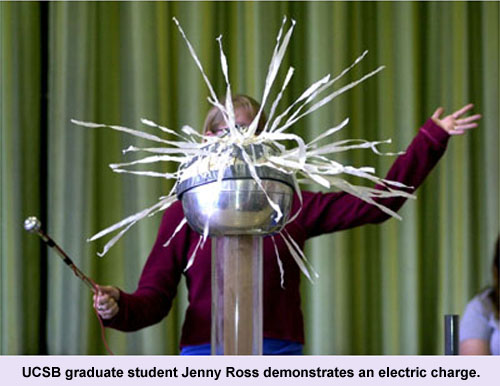
Students learn about everything from electric charges in the Van de Graaff demonstrations to angular momentum, which is demonstrated with a volunteer seated on a spinning stool, holding a spinning bicycle tire.
 "The
idea is to make it look surprising and then introduce the words and concepts
to describe why things are this way," said Ms. Fygenson. "We're trying
to be sensitive to the new science standards and help elementary school
teachers who don't necessarily have science backgrounds to address those
standards."
"The
idea is to make it look surprising and then introduce the words and concepts
to describe why things are this way," said Ms. Fygenson. "We're trying
to be sensitive to the new science standards and help elementary school
teachers who don't necessarily have science backgrounds to address those
standards."
Ms. Heiden said she appreciates the resources UCSB offers to local teachers, at no cost. The Physics Circus is backed by private donations and a University of California Office of the President Faculty Outreach Grant.
Different Physics Circus programs are offered for junior high students, who can participate in a "science night" presentation with one-on-one demonstrations, and full labs for high school students.
Currently, the Physics Circus tours from Santa Maria to Ventura but presenters hope to target more kids in the North County.
Some of the demonstration equipment is available to the public through UCSB's Community Science Center, which is open by appointment.
Graduate and undergraduate students who teach the courses are also expected to benefit.
"It's one of the most rewarding things I've done here," said freshman Chris Maffeu, a physics major. "It's cool to get the kids excited about something."
There's also the educational component.
"There's a lot of innocent questions that force someone who has been trained with five or six years of course work to rethink what they know," said Ms. Fygenson.
"They ask great questions," confirmed graduate student Colleen Schwartz. "They're so funny. And sometimes they really surprise you with what they know."
It also gives the young UCSB presenters the chance to think about teaching, a career Mr. Maffeu said he might consider.
"I think this is a really good way to get undergraduate students looking towards a science teaching career," said Ms. Fygenson, who is in her first year advising the program. "All too often, our students come out of this thinking that the only way they'll contribute is if they advance science with research."
For more information about the UCSB
Physics Circus, please visit http://www.physics.ucsb.edu/~circus/
.
return
to UCSB Physics home page
Updated December 26, 2002.
development@physics.ucsb.edu