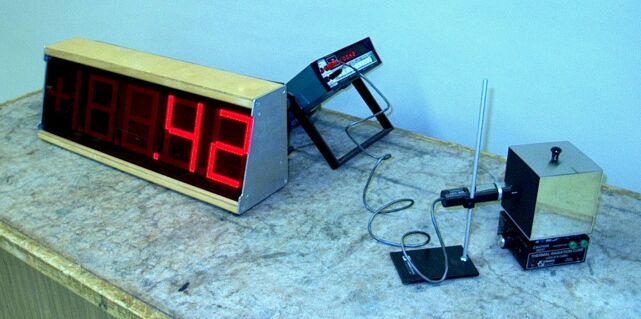
At left in the photograph is a hollow aluminum cube that has one side with a flat black surface, one with a dull aluminum surface, one with a flat white surface, and one with a polished aluminum surface. The cube is heated by a 100-W (130V) bulb, which sits inside it. Mounted on the stand next to the cube is a small thermopile, which is connected to the voltmeter, whose reading is shown on the large display. With the cube heated and at equilibrium, place the thermopile in front of one of the cube faces, and open the shutter for a short time, either by sliding the ring toward the front (as shown above) or by pressing the shutter down. (Keeping it open too long could cause heating of the thermopile, which could change the reference voltage and alter the response.) Now place it the same distance from each of the other faces, and take a similar measurement for each face. The different readings you observe for the four cube faces show the differences in emissivity among them.
The apparatus shown above is a radiating cube with a different surface on each of its side faces, also called Leslie’s cube. As noted above, the cube is heated by a 100-W bulb, whose intensity you control by means of the knob on the base of the unit. The two green banana jacks on the side facing the thermal radiation sensor in the photograph go to a thermistor embedded in one corner of the cube, to allow for measurement of its temperature. Printed on the panel with the green jacks is a table of thermistor resistance vs. temperature. (A more extensive table is also available.) Unless you wish to show the precise relationship between temperature and radiated power, it is usually not necessary to know the temperature, but only that it will not change as you are making your measurements. The radiation sensor is a small thermopile, which develops a potential difference between its terminals that is proportional to the radiant power absorbed. When set as shown in the photograph, the front face of the sensor case is 4.3 cm from the cube face. (The face of the sensor itself is recessed by a few millimeters.)
Because of their temperature, all bodies (solid objects and bodies of liquid or sufficiently dense gas) emit thermal radiation. This is a continuous spectrum of radiation, over which the distribution of frequencies and intensities depends mainly on the temperature of the radiating body. Objects can also absorb thermal energy from their surroundings. Experiments show that a body whose surface absorbs all thermal radiation incident on it emits a spectrum whose characteristics depend only on its temperature, and that all such objects emit the same spectrum when they are at the same temperature. Since such objects do not reflect any light, they appear black. (One can make such an object by coating any object with a thin layer of flat black pigment.) For this reason, they are called blackbodies, and their emissions are called blackbody radiation.
In the late 19th century, three laws that describe blackbody radiation were determined by experiment. Stefan’s law gave the total power per unit area emitted by an object, its radiancy, as a function of its temperature. Wien’s displacement law gave the frequency (or the wavelength) at which the intensity of the radiation was a maximum, as a function of temperature. Wien also found an expression for the spectral radiancy, the distribution of intensity vs. frequency as a function of temperature. The pages for demonstrations 92.24 -- Temperature of a radiating body, and 92.25 -- Spectrum of a radiating body, describe these laws and the development of a theoretical model from which they could be derived. This process led to Max Planck’s development of his radiation law, and with it the birth of quantum mechanics.
Of these laws, the one that applies to this demonstration is Stefan’s law, which for an ideal blackbody is
RT = σT4,
where σ, the Stefan-Boltzmann constant, equals 5.6704 × 10⁻⁸ W/(m2-K4). The total power per unit area emitted by a heated object, RT, increases steeply with temperature, and the change in radiated power with temperature is thus quite large. For example, doubling the temperature results in a 16-fold increase in the radiancy.
For an ideal blackbody, the radiated power depends only on the temperature. For most objects, however, surface properties have at least some effect on the radiated power, and sometimes the effect can be rather large. The equation for Stefan’s law becomes:
RT = eσT4,
where e, the emissivity, is a property of the material of the radiating object.
The other law that is important to this demonstration is Kirchhoff’s law for radiation. Imagine a large evacuated enclosure in which two small opaque bodies are suspended far from each other on fine threads. The walls of the enclosure are opaque and kept at a constant temperature. The opaque bodies and walls can exchange energy with each other only by radiation. If the system is in thermal equilibrium, then the rate at which each body emits radiation, e, equals the rate at which it absorbs radiation, a. So for body 1, e1 = a1, and for body two, e2 = a2, and
(e1/a1) = (e2/a2) = 1
This equation is Kirchhoff’s law for radiation. We see that if the rate of absorption of one body is greater than the rate of absorption of the other body, so must its rate of emission be greater than that of the other body. That is, if a1 > a2, then it must also be that e1 > e2. This agrees with our experience that good absorbers are also good emitters.
As noted above, the cube in this demonstration has one face that is flat black, one that is a dull white, one that is dull aluminum, and one that is polished aluminum. Measurements with the thermopile show that the black face emits the most, very closely followed by the white face (which emits almost as much), the dull aluminum face emits about 30 percent as much as the black face, and the polished aluminum face emits about four or five percent as much as the black face. With the cube set as it was for the photograph above, the thermopile readings for the different surfaces were:
Surface Reading Black 6.6 mV White 6.5 mV Dull Aluminum 2.0 mV Polished Aluminum 0.24 mV Taking readings for different cube temperatures requires time for the cube to reach equilibrium at each temperature. This is possible if you can continue lecturing during the equilibration period for each setting change.
References:
- 1) Halliday, David and Resnick, Robert. Physics, Part Two, Third Edition (New York: John Wiley & Sons, Inc., 1978), p. 1093.
- 2) Eisberg, Robert and Resnick, Robert. Quantum Physics of Atoms, Molecules, Solids, Nuclei, and Particles (New York: John Wiley & Sons, Inc., 1974), pp. 7-8.