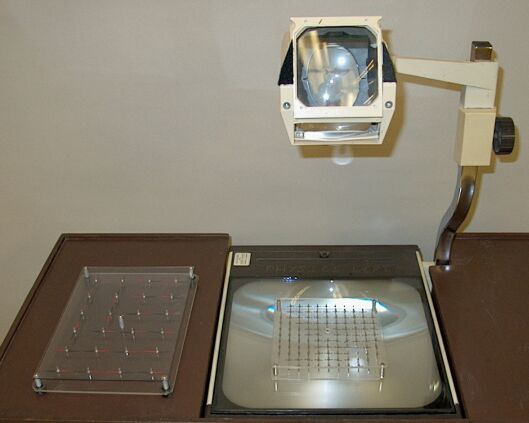
The two apparatuses shown above are arrays of compass needles, which represent arrays of domains in ferromagnetic materials. If the needles are aligned at the start, you can either shake the apparatus to scramble their orientations, or you could use the small magnet to change their pattern of orientation. If the needles are not all aligned at the start, you can either use the small magnet to align them, or try to tap them into alignment. The compass needles in the apparatus sitting on the glass of the projector are in the shape of a small arrow, so the class will be able to see their north-south directions in the projected image. The needles in the other apparatus are symmetrical, so that the projected image will not show their north-south polarity, but only their directional orientation.
In ferromagnetic materials, each atom possesses a magnetic dipole, and the magnetic dipoles of neighboring atoms align parallel with each other in groups called domains. These domains, which range in size from about 0.1 mm to a few mm in length, thus have permanent magnetic dipoles. In a given piece of ferromagnetic material, the energy is lowest if the orientations of these domains are random. In an unmagnetized piece of material, the domains are randomly oriented, so that their magnetic moments cancel each other, and the material itself does not have a magnetic moment. It is, however, strongly attracted by a magnetic field. When you place it in a magnetic field, larger domains whose magnetic dipoles are aligned with the field grow at the expense of neighboring smaller domains whose dipoles are not aligned with it, and domains whose magnetic dipoles are not aligned with the magnetic field rotate so as to align them with it. The material thus becomes magnetized. It now possesses a magnetic dipole, and it will attract other magnetic objects, whether or not they are themselves magnetized.
Besides placing the piece of material in a magnetic field, it is possible to align or randomize its domains by delivering a mechanical shock to the material. For example, you can magnetize a bar or rod of iron by striking one end of it with a hammer, or by repeatedly dropping it on its end, and you can demagnetize it by dropping it so that it lands along its length in some random way. (See demonstration 68.12 -- Induced magnetism.)
In some materials, the domains may be regular in size and shape, but very often, their shapes and sizes are at least somewhat random, so that their arrangements are not as regular as the arrangements of compass needles in this demonstration. Still, when you tap or shake these models, or use the small bar magnet to align or misalign their dipoles, they can give a reasonably good imitation of the way that magnetic domains in a piece of ferromagnetic material realign themselves as a result either of a mechanical impulse or the presence of a magnetic field.